The National Buildings Database
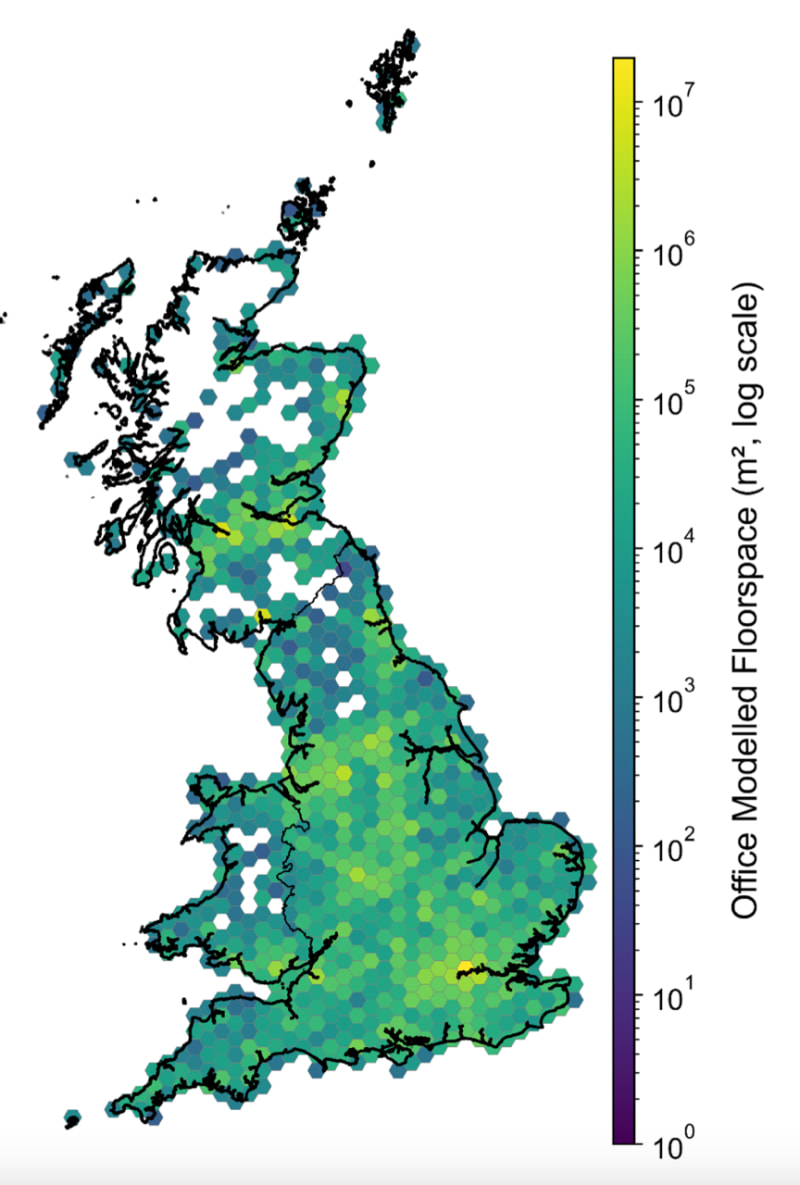
Between 2023 and 2026 our group at UCL has produced the National Buildings Database (NBD) for the UK Department of Energy Security and Net Zero (DESNZ). This covers all buildings in England, Wales and Scotland, both domestic (houses and flats) and non-domestic (offices, shops, factories, warehouses etc), plus mixtures of the two (e.g. flats over shops). The 30 million dwellings are at present recorded with addresses, footprints and energy use but without 3D geometry. The 2.1 million non-domestic premises have full geometric descriptions with numbers of storeys and floor areas, plus materials of construction, estimates of age, and data on heating systems and energy efficiency measures installed. The activities in each premises are classified by some 485 categories, down to the level of ‘bingo hall’, ‘lifeboat station’ or ‘garden centre’. Energy Performance Certificates (including domestic EPCs) and Display Energy Certificates are all attached, as are annual gas and electricity meter data.
The Database will allow DESNZ to carry out research into energy use and carbon emissions, to inform government strategy and policy on improving energy efficiency and reducing energy bills. NBD will be used for examining practical approaches to low carbon retrofitting for specific subsets of the stock, and for investigating the potential for integrating low carbon and renewable energy technologies. Through inclusion of every premises in Great Britain, NBD allows for specific segments and subsets of the stock to be identified and analysed, for example all public sector buildings, or all data centres. The rich detail allows for policy options to be developed and assessed based on actual premises and their features, for example estimating rooftop solar potential or supporting and evaluating updates to regulation. The spatial nature of the data allows for localised energy planning and decarbonisation action at scale, for example identifying opportunities for heat networks. Data from NBD will be made available in aggregate and anonymised form for other users.
A report containing detailed statistics on each sector of the non-domestic stock has been published, together with downloadable data tables, at gov.uk